
Dynamic tariff
Benefit from lower electricity prices at the right moments. With a dynamic tariff, your electricity price follows the energy market, allowing you to save money by planning your consumption smartly or by controlling it automatically.
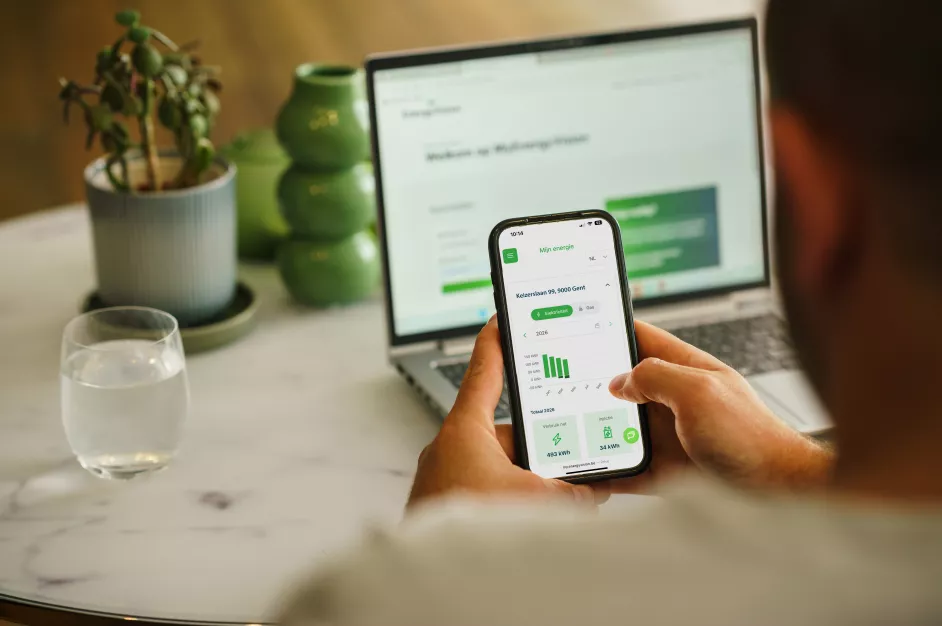
Electricity prices that change every 15 minutes
With a dynamic tariff, you do not pay a fixed or average electricity price, but the actual market price which can change every 15 minutes. This allows you to use more electricity when prices are low and less when prices are higher.

Goedkope stroom Dynamisch
Your electricity price fluctuates every 15 minutes in line with the energy market.
- Tariff type: Dynamic
- Contract duration: Indefinite
- Can be cancelled monthly without fees
- Fossil gas available: In combination
- Region: Flanders
A dynamic tariff is an energy contract where the electricity price fluctuates every 15 minutes in line with prices on the energy market. This means there can be up to 96 different price periods per day. To maximise your savings, you need to monitor the electricity prices yourself and shift your consumption as much as possible to times when electricity is cheaper.
With a fixed tariff, your electricity price remains the same for the duration of your contract. With a variable tariff, the price changes monthly. A dynamic tariff tracks the energy market most closely, allowing you to make the most of fluctuations in the electricity price.
A dynamic tariff is particularly beneficial if you use a lot of electricity and can time your usage to coincide with electricity prices. You can do this, for example, by setting your electric car, heat pump or other smart appliances to run automatically when electricity prices are low.
You can also benefit from a dynamic tariff if you spend a lot of time at home and can actively monitor market prices.
That depends on generation and market prices. On sunny afternoons, market prices are often lower, which means the injection compensation may be limited or even negative. A home battery or smart control system can help you get more value from your own generation.
That depends on your consumption pattern. Customers who can shift their consumption to cheaper off-peak hours can save money. Those who mainly consume during expensive peak periods may end up paying more than they would with a standard contract. With a fixed (or partially fixed) price, you do have greater certainty.
Each supplier determines its own:
- fixed fee
- margin on the market price
- injection formula
As a result, final costs can differ significantly, even when the underlying market price is identical.
The market price is just one component of the final bill. With a dynamic contract, you will also still pay:
- net tariffs
- taxes and contributions
- capacity charge
- subscription fees or a fixed fee charged by the supplier
- VAT
You can easily keep track of the market price via this link. Prices for the following day are usually announced around 12 noon.
Yes. When there is abundant solar and wind generation and low demand, market prices can become negative. During such periods, the energy component of your consumption price can be very low or even negative.
However, other costs such as grid charges, levies, and VAT remain payable. These costs are independent of your supplier and are therefore the same regardless of the supplier.
To opt for a dynamic tariff, you must meet a few conditions:
- You must have a digital meter. This is necessary so that we can receive your actual consumption data every 15 minutes via the network operator.
- You do not have an exclusive night-time meter.
- You live in Flanders. We currently only offer this tariff in Flanders.
Don’t have a digital meter yet? Then please contact your network operator. Once your digital meter is active, you can apply for a dynamic tariff.
As well as the electricity price per quarter of an hour, it is also important to take the capacity tariff into account. This part of your network costs is determined by your highest consumption peaks and, in Flanders, does not currently take the situation on the energy market into account. Even when there is plenty of green electricity available or there are surpluses, high consumption peaks can still increase your capacity tariff.
You should therefore time your consumption to coincide with periods when electricity is cheap, but make sure your peak consumption does not rise too high. A higher capacity tariff can, in fact, cancel out some of the savings made through cheap electricity.
The capacity tariff is part of your grid charges that is based on your highest consumption peaks. The grid operator not only looks at how much electricity you use, but also at how much power you draw from the grid at any given moment.
For example, if you use a charging point, a heat pump and an oven at the same time, this creates a higher consumption peak. The higher these peaks are, the greater the strain on the electricity grid and the higher your capacity charge may be.
The capacity charge currently accounts for around a quarter of the distribution network costs on your electricity bill. By spreading out high consumption over time, you can limit your consumption peaks and avoid unnecessary increases in your network costs.
No, EnergyVision uses monthly billing for dynamic contracts. You no longer have to pay any advance payments; each month, you are billed for your actual consumption at the correct price. This means you will no longer receive an annual settlement either. So there are no surprises later on.
Do you have any questions?
Please contact us

Mail us


